


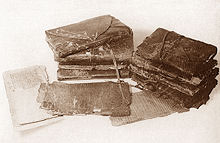
Nag Hammadi texts
I was asked some time ago about Gnosticism. If you recall, Pastor Phil has even mentioned Gnostic thought in some of his sermons from the book of Hebrews. So, what is Gnosticism? What about those “lost Gospels” we hear about on TV? Let’s take a look:
Gnosticism is modern term to describe a number of religious and philosophical perspectives that existed before the establishment of Christianity and extended into the first two centuries after the crucifixion of Jesus. In reecent years there has been a been a resurgence in this school of thought due primarily to the findings of their writings at Nag Hammadi, Egypt in 1945 as well as books like Dan Brown’s, “Davinci Code”. The term “gnosticism” is derived from the Greek word gnosis (knowledge) because secret knowledge was so crucial a doctrine in gnosticism. These writings found at Nag Hammadi are often called Christen Gnostic writings because they attribitute themselves to Christian’s such as the Prayer of the Apostle Paul, the Gospel of Thomas, the Gospel of the Egyptians, the Sophia of Jesus Christ and more. However, few scholars believe at all that they were written by the persons they were attributed to.
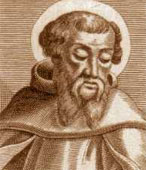
Irenaeus
Gnosticism was and is considered heresy in the early church as well as today. Irenaeus, an early church leader from the 3rd century reported that one of the reasons the Apostle John wrote his Gospel was to refute the views of Cerinthus, an early Gnostic. Over against the gnostic assertion that the true God would not enter our world, John stressed in his Gospel that Jesus was God’s incarnate Son.
Gnosticism emerged in schools of thought within the church in the early second century and soon established itself as a way of understanding Christianity. By the end of the second century many of the Gnostics belonged to separate, alternative churches or belief systems viewed by the church as heretical. Gnosticism was a major threat to the early church; and the early church leaders, such as Irenaeus (died about 200), Tertullian (died about 220), and Hippolytus (died about 236), wrote many volumes against it.
Although wide variations existed among the many gnostic sects, certain major features were common to most of them:
- the separation of the god of creation from the god of redemption
- the division of Christians into categories with one group being superior
- the stress on secret teachings which only divine persons could comprehend
- the exaltation of knowledge over faith.

Marcion
 Gnostics generally distinguished between an inferior god whom they felt was responsible for the creation and the superior god revealed in Jesus as the Redeemer. This was a logical belief for them because they opposed matter to thought in a radical way. Matter was seen as inferior, sin-causing, and always deteriorating; thought or knowledge distinguished persons from matter and animals and was imperishable, capable of revealing god, and the only channel of redemption. The gnostic Marcion rejected the Old Testament, pointing out that the lesser or subordinate god revealed in it dealt with matter, insisted on law rather than grace, and was responsible for our decaying, tragedy-filled world. The god who revealed himself in Jesus and through the additional secret teachings was, on the other hand, the absolute god, and was not incarnate in human flesh because the absolute god would not enter evil matter—Christ only seemed or appeared to be a person, but He was not.
Gnostics divided Christians into groups, usually the spiritual and the carnal. The spiritual Christians were in a special or higher class than the ordinary Christians because they had received, as the elect of the good deity, a divine spark or spiritual seed in their beings which allowed them to be redeemed. Gnostics claimed that the spiritual Christians were not responsible for what they did and could not really sin. Thus they could act in any way they pleased without fear of discipline.
Again, gnostics always placed great stress on secret teachings or traditions. When a person received the gnosis or true knowledge, he became aware of his true identity with a divine inner self, was set free (saved) from the dominion of the inferior creator god, and was enabled to live as a true child of the absolute and superior deity. To be able to attain to your true destiny as the true deity’s child, you had to engage in specific secret rituals and in some instances to memorize the secret data which enabled you to pass through the network of powers of the inferior deity who sought to keep people imprisoned. Salvation was seen by the gnostics in a cosmic rather than a moral context—to be saved was to be enabled to return to the one true deity beyond this world.
The Gnostics thought faith was inferior to knowledge. The true sons of the absolute deity were saved through knowledge rather than faith. Yet what this precise knowledge was is quite vague. It was more a perception of one’s own existence that solved life’s mysteries for the Gnostic than it was a body of doctrine. The knowledge through which salvation came could be enhanced by participation in rituals or through instruction, but ultimately it was a self-discovery each Gnostic had to experience.
What about all those lost Gospels? I believe that were not ever true Gospels in the first place 🙂
My friend “Pilgrim of Truth” (Wes Bishop) replied to this question:
.
My question then to this is how do we know that Paul along with the other New Testament writers did not lie in their writings and that the gnostic are in fact (or some of them) the ones telling the truth. If mainstream Christianity were to change today and pervert the teachings and history of the Bible, and only you were left to tell the truth then you would be considered neo-gnostic. I have great respect for the Apostle Paul as a writer but I have heard accounts that he would preach about the second coming of Christ which was to occur in the next week to gain converts only to turn around and say “No its the week after next” when it did not come to pass.
.
Also why did Gnostics split Christianity into two groups? Peace.
This is my reply to “Pilgrim of Truth”:
.
Your Question is: “……….how do we know that Paul along with the other New Testament writers did not lie in their writings and that the Gnostic are in fact (or some of them) the ones telling the truth.” ?
.
First, I would point out that Paul was chosen and commissioned by Jesus in Acts (Acts 9:15). The complete story of Paul’s conversion is contained in Acts 9: 1-22. I would also note that Paul’s writings have been dated much earlier than any of the Gnostic writings. Indeed, the majority of Paul’s Canonical writings have been dated 50-60 AD, that’s just 13-23 years after the death of Christ. I could find only one Gnostic text that could have been remotely dated that early. This is the Gospel of Thomas, which was probably written in the 2nd century 100-150 AD. Some scholars believe that it may have been written as early as 50 AD.
.
As far as truth? Essentially, you must decide this yourself. We choose to believe what we believe. I always start with Jesus, then move to the Apostles because Jesus commissioned the Apostles directly and chose them to tell the world the Good News. Most off all, as I have accepted Christ and turned to Him in trust and in a relationship, I have seen a change in my life. I have experienced many of the very same experiences mentioned in the New Testament. My life has changed.
.
Additionally, I would note that I believe that God revealed Himself through the Holy Scriptures. This story starts with Ancient Israel. I am a monotheist, believing in one God, the God of our fathers. Marcion and the Gnostic’s reconfigured God’s Words to us and essentially semi-paganized Christianity. The early church fathers recognized this and wrote extensively against it. Indeed, the Apostles John as well as Paul saw and preached against the very same Heresy. The truth, I believe is deeply rooted in the Old Testament. As you read the Bible as one book, inspired by a God who is passionately in love with His people, you see the story of God revealing Himself to us. The Old testament is the preparation of the coming of the Messiah, Jesus. Gnosticism is essentially a platonic dualism. The ancient Greco-Roman world was essentially pagan. God has warned us deeply about both from the beginning of time.
.
So, are the Gnostics telling the truth? Is there a god that created this world that is essentially an inferior god and was Jesus the superior god? Is all matter evil? As I look into the eyes of a child…I say no….as I read your blogs….I say no…..you are not evil. Is secret knowledge the path to salvation that is only for a few? I believe no. God’s grace is extended to all that accept it through Jesus Christ, God in the flesh, come to save mankind as well as show mankind through His actions how to love, how to live a fulfilling life and how to be all that God wants us to be. After all…God created us…He should be the writer of the instructions (at least in my mind…He knows us best).
.
You mentioned: “If mainstream Christianity were to change today and pervert the teachings and history of the Bible, and only you were left to tell the truth then you would be considered neo-gnostic.” “If’s” are great for contemplating. However, I do not believe that Christianity today perverts the teachings of the Bible. If anything, the Bible has become more accessible to all people and therefore is less likely to be misunderstood. I will admit that one cannot understand the teaching of Christ or God’s Words to us without reading them. I believe that God’s Word stands on it’s own. It can be attacked, it can be slandered, it can be used out of context….but essentially…..it stands on its own and has continued to stand like a rock over many thousands of years. The key is to read and study it for yourself if you do not believe what you are told about it. I would certainly agree that there are and there probably always will be people and groups of people who will only accept God’s Words from the perspective they build. People like Fred Phelps (GodHatesFags.com).
.
You also mentioned: “I have great respect for the Apostle Paul as a writer but I have heard accounts that he would preach about the second coming of Christ which was to occur in the next week to gain converts only to turn around and say “No its the week after next” when it did not come to pass.” Interesting story, I would ask where you heard this for it to be true. I have not read this in his writings nor have I seen it in the historical record. Please share with me the source for this information.
.
Lastly, you ask: “….. why did Gnostics split Christianity into two groups?” I cannot give a definitive answer to this as I did not live at that time. However, I believe that many people just choose to believe something else. Many people just choose not to believe what God has revealed to us in the Bible. That is a choice that only a truly loving God would allow. I would note that your question assumes that Gnostics were Christian. While they believed in Christ, they chose to ignore the teachings of his closest disciples and students, and indeed his very own teachings and make Him something He wasn’t. I do not consider Gnostics Christian. They only get this label because they include Jesus in their writings. I would note that I could write adoringly about Adolf Hitler and say that he was actually a benevolent man that saved Germany through his secret teachings. The world would call me a Nazi, even though I misrepresented what and who Adolf Hitler was. That may not be the best analogy, however, I believe you can get the point of what I mean
.
Thank you for your questions. It is essential to know that we each have been given the will to believe what we want. I believe the historical record in itself as everything else in creation attest to the presence of one God, revealed through His inspired words, indeed, stories, contained in the Holy Scriptures. God bless you and again, thank you for your questions.